
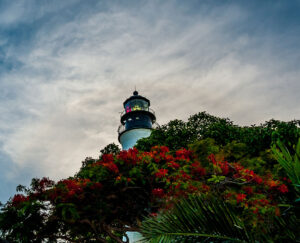
Rising 73 feet above Whitehead Street, the Key West Lighthouse stands as an enduring symbol of maritime resilience in the Florida Keys. Built inland after the Great Havana Hurricane of 1846 leveled the original coastline structure, this historic beacon guided schooners, military vessels, and wrecking sloops through shallow reef waters for over 120 years. Today, operated by the Key West Art & Historical Society, the Key West Lighthouse Museum offers travelers an engaging look into 19th-century seafaring history, keeper lifestyles, and unmatched aerial vistas.
Visiting the site provides a hands-on experience, but visitors must prepare for the physical reality of the ascent. Unlike modern observation decks, there is no elevator inside the Key West Lighthouse tower. Reaching the observation gallery requires climbing 88 narrow, spiraling iron steps winding through the brick cylinder. Those who make the climb are rewarded with 360-degree vistas across Old Town, coral reefs, and the Gulf of Mexico. This guide details everything you need to know about touring the Key West Lighthouse, including climbing tips, historical facts, and morning itinerary planning.
Best Things to Do at the Key West Lighthouse and Keeper’s Quarters
A visit to this maritime compound involves more than just a quick glance at an old tower. Here are the top activities and sights to experience when exploring the Key West Lighthouse Museum.
1. Conquer the 88-Step Spiral Climb of the Key West Lighthouse Tower
The signature highlight of your visit is ascending the historic spiraling staircase to the observation catwalk. Stepping through the heavy ground-floor doorway, you enter an authentic 19th-century brick shaft where 88 open-grate iron steps wrap tightly around a central support column.
Because the Key West Lighthouse tower was engineered as a utilitarian navigational aid, the stairwell is narrow. There are no rest platforms or elevators; visitors ascend and descend along the same spiraling steps. Small porthole windows offer views of the tree canopy while coastal breezes cool the brickwork. Stepping onto the iron gallery delivers some of the most scenic views in Key West, showcasing the four-by-two-mile island beneath your feet.
2. Tour the Restored 1887 Keeper’s Quarters
At the base of the tower sits the historic Keeper’s Quarters, built in 1887 in Victorian stick style to replace an earlier storm-damaged residence. Now the centerpiece of the Key West Lighthouse Museum, the restored home reveals daily keeper life before automation.
The Key West Lighthouse Museum showcases period furnishings, historical logbooks, uniforms, and maritime photographs. Exhibits detail keeper Barbara Mabrity, who served the Key West Lighthouse for nearly four decades through epidemics, war tensions, and hurricanes.
3. Inspect the Giant First-Order Fresnel Lens Up Close
Inside the climate-controlled gallery sits a colossal First-Order Fresnel lens. Invented by Augustin-Jean Fresnel in 1822, these multi-prism glass assemblies revolutionized maritime safety by focusing light into a beam visible up to 20 nautical miles away.
Standing beside this glass masterpiece reveals 19th-century optical engineering that protected ships from shallow coral banks. Exhibits illustrate how keepers spent hours polishing brass, trimming wicks, and replenishing oil reservoirs to keep the beam shining.
4. Relax in the Shaded Courtyard of the Key West Lighthouse Museum
After conquering the climb of the Key West Lighthouse tower, relax in the lush gardens of the Key West Lighthouse Museum. Shaded by banyans, royal palms, and blooming frangipani, the brick-paved courtyard offers a peaceful respite. Interpretive signs spaced throughout the grounds detail auxiliary historic structures, including the brick oil storage house where flammable fuels were secured away from the living quarters.

The Whitehead Street Anchor
One of the greatest advantages of visiting the Key West Lighthouse is its prime location in Old Town. Situated at 938 Whitehead Street, the landmark serves as a major cultural anchor along one of the island’s most storied thoroughfares. However, many visitors miss out on the most efficient way to tour the area, resulting in long waits under the midday sun.
The Whitehead Street Morning Combo Strategy
The Ernest Hemingway Home & Museum sits literally directly across the street at 907 Whitehead Street. Rather than visiting these two sites separately or arriving in the afternoon when pedestrian traffic peaks, follow the Whitehead Street Morning Combo Strategy:
- 8:45 AM – 9:00 AM: Arrive at 938 Whitehead Street and purchase your admission tickets.
- 9:00 AM – 9:45 AM: Climb the 88 steps right at opening to beat midday brick heat and stair traffic.
- 9:50 AM: Walk directly across Whitehead Street to the Ernest Hemingway Home & Museum entrance.
- 10:00 AM – 11:30 AM: Tour Hemingway’s estate and grounds before large tour bus crowds arrive.
Following this schedule offers distinct advantages:
-
Enter at Opening (9:00 AM): Entering the Key West Lighthouse Museum at opening ensures the brick shaft remains cool from overnight breezes and avoids two-way foot traffic on the narrow spiral staircase.
-
Clear Morning Photography: Morning sun lights the Atlantic and Gulf coasts with minimal haze, creating clear photography conditions from the observation gallery of the Key West Lighthouse tower.
-
Beat the Hemingway Lines: Walking directly across the street lets you explore Hemingway’s writing studio, meet the polydactyl cats, and stroll the grounds before cruise tour buses arrive at 10:30 AM.
Architectural Feats and Engineering of the 1848 Tower
Beyond its maritime history, the structure is an exceptional study in 19th-century utilitarian engineering. Exploring its masonry highlights the diverse and unique architecture styles found throughout Key West.
- 1825: The original 65-foot tower is constructed on coastal Whitehead Point.
- 1846: The Great Havana Hurricane completely destroys the 1825 tower and kills 14 people sheltering inside.
- 1848: A new 46-foot brick tower is built on an inland limestone ridge 15 feet above sea level.
- 1894: Workers raise the tower by 11 feet to its current 73-foot height to clear tall trees and buildings.
- 1969: The U.S. Coast Guard decommissions the beacon, paving the way for its opening as a museum.
The 1846 Hurricane and the 1848 Inland Reconstruction
The original Key West Lighthouse was completed in 1825 on Whitehead Point along the coast. On October 11, 1846, the Great Havana Hurricane struck the island with a 15-foot storm surge. The keeper’s family took shelter inside the tower, believing it safe, but violent surf undermined the foundation. The 65-foot structure collapsed, killing fourteen people inside, including the keeper’s children.
Recognizing coastal vulnerabilities, the Lighthouse Board rebuilt the beacon inland on Old Town’s highest natural limestone ridge, fifteen feet above sea level. Completed and re-lit in 1848, the new brick tower stood 46 feet tall with thick, tapering masonry engineered to survive hurricane winds.
The 1894 Elevation Project
As Key West flourished in the late 19th century, residential construction boomed. Growing trees and two-story Victorian homes eventually began obscuring the beacon’s beam from approaching ships.
In 1894, the Lighthouse Service disassembled the lantern room and added an 11-foot brick extension. This raised the Key West Lighthouse tower to its current height of 73 feet, elevating the focal plane to 86 feet above sea level and ensuring an unobstructed light across the Florida Reef until decommissioning in 1969.
Historic Landmarks Near the Key West Lighthouse
Rather than confusing the lighthouse with distant attractions across town, focus your walking tour on immediate cultural neighbors along the southern corridor of Whitehead Street. These sites rank among the top historic Key West landmarks you can reach on foot within minutes:
1. The Ernest Hemingway Home & Museum (907 Whitehead Street)
Located directly across the street, this 1851 Spanish Colonial estate was Hemingway’s home in the 1930s. Tour his writing studio, see the island’s first in-ground pool, and pet resident polydactyl cats.

2. The Key West Butterfly & Nature Conservatory (1316 Duval Street)
A three-block walk south, this climate-controlled glass conservatory features fifty butterfly species, exotic birds, and flamingos, serving as a cool retreat after your climb.
3. The Southernmost Point Buoy (Whitehead & South Streets)
Four blocks south along Whitehead Street stands the painted buoy marking the southernmost point of the continental U.S., ideal for morning photos before tour crowds form.

4. Mile Marker 0 of U.S. Highway 1 (Whitehead & Fleming Streets)
A five-block stroll north on Whitehead brings you to the end of the Overseas Highway for a classic souvenir snapshot at the “Mile 0” road sign.
Final Thoughts: Experiencing the Maritime Soul of Old Town
Visiting the Key West Lighthouse connects you directly to the maritime guardians who safeguarded Florida’s coastlines. By dispelling modern myths, preparing for the 88-step climb, and coordinating your visit with the Hemingway Home across the street, you can experience a rich cultural corner of the island. Climb the historic Key West Lighthouse tower, tour the exhibits in the Key West Lighthouse Museum, and enjoy the views that defined island history.
FAQs
Are children allowed to climb the Key West Lighthouse tower?
Yes, children are welcome to climb, but they must be able to walk up the 88 steps independently under adult supervision. Carrying infants or small toddlers in your arms while ascending or descending the narrow spiral staircase is strongly discouraged due to safety regulations.
Can you bring large backpacks or luggage up the tower?
No. Because the spiral staircase is narrow and traffic flows in both directions, large backpacks, bulky daypacks, tripods, and luggage are not permitted on the climb. The admissions desk in the Keeper’s Quarters will securely store your bags while you visit the observation deck.
What should I wear when visiting the Key West Lighthouse?
Wear flat, rubber-soled walking shoes or closed-toe sneakers. The 88 steps are made of open-grate cast iron, which can be slippery or uncomfortable in thin flip-flops or high heels. Lightweight, breathable clothing is recommended, as the interior brick tower is not air-conditioned.
Are there discounts available for admission to the Key West Lighthouse Museum?
Yes. The Key West Art & Historical Society offers discounted admission rates for seniors (65+), active-duty military, college students with ID, and youth ages 7 to 15. Children under six enter free of charge. Purchasing tickets online in advance through the official museum website also provides a discount compared to gate prices.
Is photography permitted from the observation deck?
Yes, photography is permitted and encouraged. Handheld cameras and smartphones are welcome, but selfie sticks and full-size camera tripods are prohibited on the narrow catwalk to avoid obstructing other guests.

